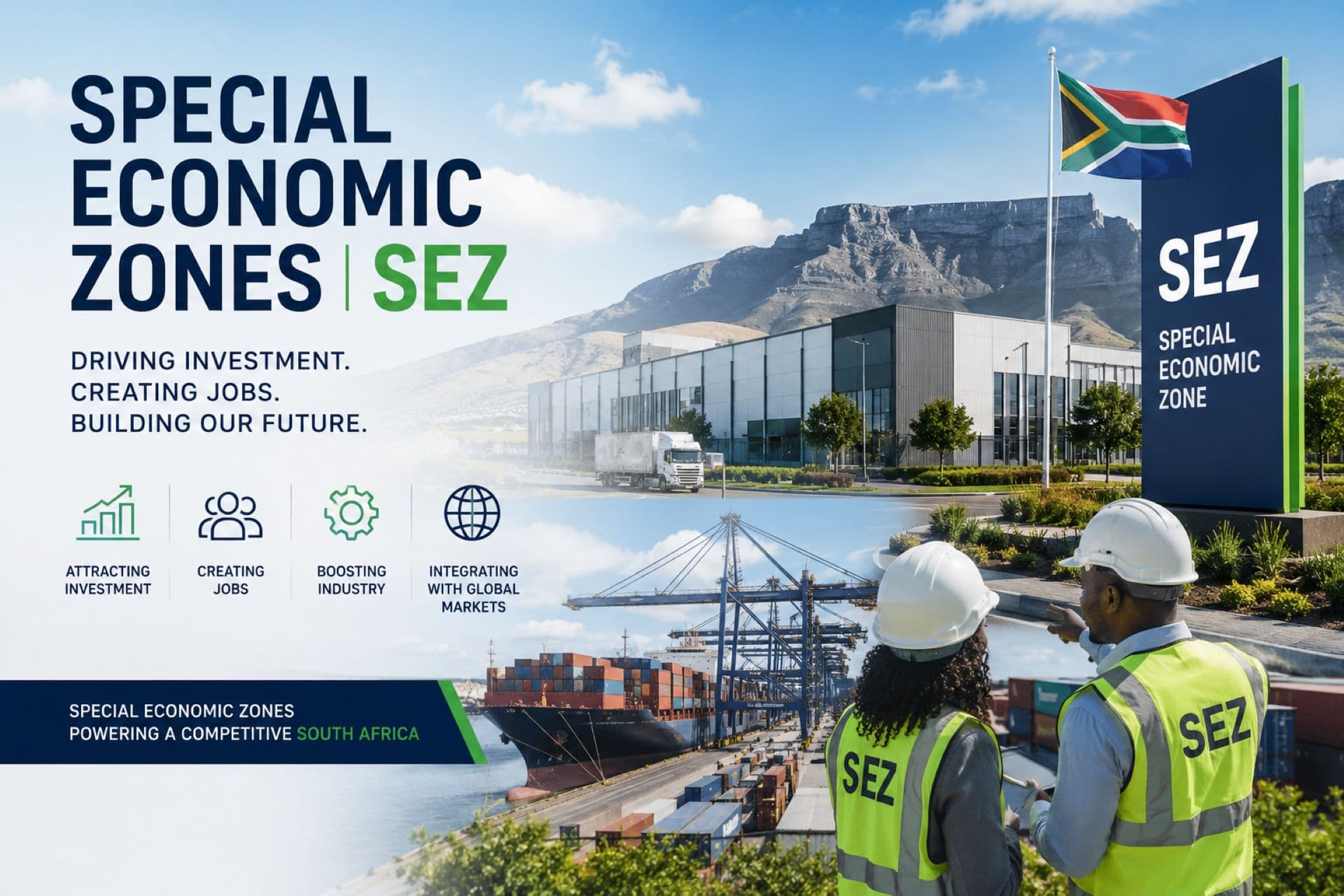
South Africa’s Special Economic Zones are being positioned for a stronger role in industrial growth, after generating R14.8 billion in revenue and supporting more than 30,000 jobs across key sectors.
Deputy President Paul Mashatile said the programme had drawn investment into industries including automotive production, agro-processing and renewable energy, reflecting its importance in government’s wider economic development plans.
Speaking at the Second International Special Economic Zones Conference in Durban, Mashatile said the results, drawn from a World Bank study, showed that the zones had become important instruments for attracting capital, expanding production and supporting employment.
The programme has its roots in the Industrial Development Zone initiative, launched in 1997 to establish competitive industrial hubs, promote exports and deepen South Africa’s manufacturing capacity.
Over time, this approach was broadened into the Special Economic Zones model, with a stronger emphasis on inclusive development, job creation and regional industrialisation.
Mashatile highlighted the Tshwane Automotive Special Economic Zone and the Coega Industrial Development Zone as examples of how targeted industrial spaces can support supply chains, improve skills and drive investment into provincial economies.
Coega, which was designated in 2001, remains one of the country’s most prominent early industrial zone projects. By 2010, government had invested more than R3 billion in the zone, helping to attract 21 investments valued at R9.2 billion and creating 2,837 operational jobs.
However, Mashatile said government had also learnt important lessons from the first generation of industrial zones. Some investments had shifted from other parts of the country rather than representing new activity, while service delivery weaknesses and poor links with nearby communities created the risk of zones becoming isolated from broader local development.
These lessons informed the shift to the Special Economic Zones framework in 2012 under the SEZ Act. The programme is now being advanced through a third phase, guided by the Spatial Industrial Development Strategy.
The strategy seeks to lift manufacturing’s contribution to gross domestic product, while using the sector’s wider economic impact to tackle unemployment and support greater participation by young people and women.
Government has placed three priorities at the centre of its manufacturing-led industrialisation agenda: decarbonisation, diversification and digitalisation.
Decarbonisation focuses on climate resilience and low-carbon technologies.
Diversification aims to expand value-added production and export opportunities.
Digitalisation is intended to improve productivity by integrating new technologies across industries.
Mashatile said South Africa’s existing network of SEZs and industrial parks provides a foundation for re-industrialisation across all provinces.
He said the country must compete for investment through strategic positioning, reliability and inclusivity, rather than relying on low costs alone.
With thousands of Special Economic Zones around the world competing for capital, Mashatile said South Africa’s zones must become centres of investment, innovation and opportunity.
He stressed that they should not function as isolated pockets of growth, but as platforms that support wider economic development, connect local businesses to regional and global markets, and strengthen South Africa’s role as a gateway to the African continent.
Staff Writer
Reporting from the front lines of the automotive industry, delivering expert analysis and the technical updates that drive the South African motor sector forward.