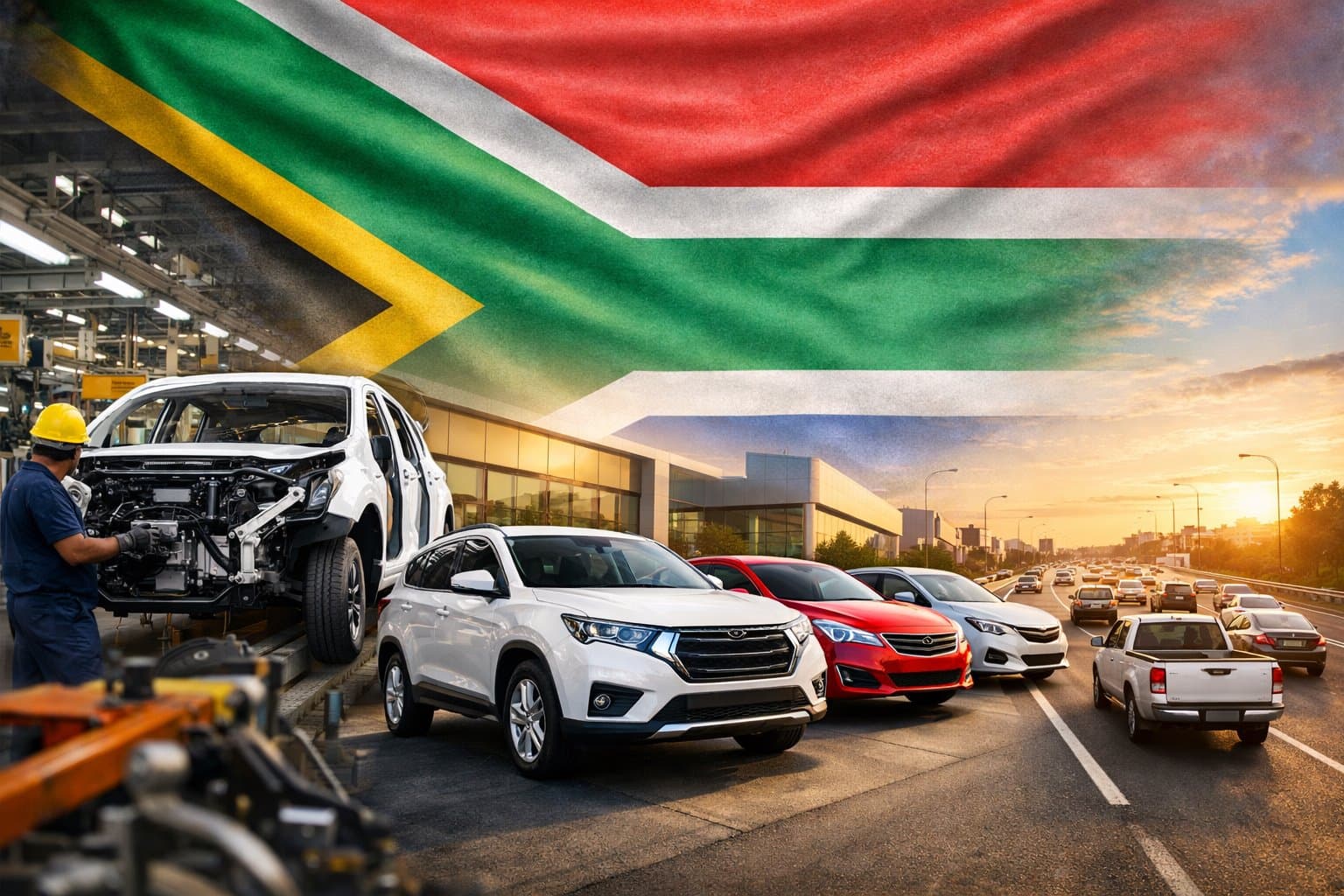
South Africa’s automotive industry closed 2025 on a strong note, achieving record export figures and robust domestic sales despite a turbulent global backdrop, according to the latest Automotive Trade Manual from naamsa, the Automotive Business Council.
Global Headwinds
The year was marked by significant international trade challenges. The United States imposed sweeping tariffs, including its “Liberation Day” duties and additional measures on imported vehicles and components. These actions unsettled global markets and created uncertainty for trade-reliant economies such as South Africa. Domestically, the industry faced rising competition and the accelerating global transition from traditional petrol and diesel vehicles towards new energy vehicles (NEVs), encompassing hybrids, plug-in hybrids and fully electric models.
Strong Performance
Despite these pressures, the sector delivered impressive results. Vehicle exports reached a record 414,271 units in 2025, up from 391,128 in 2024. The total value of automotive exports, including vehicles and components, climbed to R291 billion, an increase of R22.2 billion year-on-year. South Africa now exports vehicles to 154 countries, underlining its global reach.
On the domestic front, new vehicle sales rose sharply to 597,338 units, compared with 516,103 in 2024. Vehicle production also increased, reaching 618,077 units. The industry contributed 5.2% to South Africa’s gross domestic product, while its share of manufacturing output rose to 23.8%, reinforcing its central role in the country’s industrial base.
Investment and Employment
Seven vehicle manufacturers operate locally, investing R7.2 billion in modernising facilities and expanding model lines during 2025. The component sector attracted R5.8 billion in investment, nearly double the R2.95 billion recorded in 2024. Encouragingly, four of the seven manufacturers have already begun producing hybrid or plug-in hybrid models in South Africa.
Employment figures remained broadly stable, though with slight shifts. Direct employment by vehicle manufacturers dipped marginally to 32,115, while the component sector employed around 81,153 people.
Outlook
The outlook for 2026 is cautiously optimistic. Global trade policy remains unpredictable, and prolonged uncertainty, weaker demand from key partners and disrupted supply chains may prove more damaging than any single tariff measure. The International Monetary Fund forecasts global growth of 3.3% for 2026, while the World Bank projects 2.6%.
For South Africa, priorities include attracting investment in NEV production, deepening local supply chains and ensuring supportive government policy. A review of the country’s long-term automotive masterplan is expected in 2026, which the industry will watch closely.
- Key Performance Indicators (APDP2: 2024–2025)
| Indicator | 2024 | 2025 |
|---|---|---|
| Contribution to GDP | 5.2% | 5.2% |
| Manufacturing output share | 22.6% | 23.8% |
| Employment – manufacturers | 33,154 | 32,115 |
| Employment – component sector | 81,860 | 81,153 |
| Capital expenditure – manufacturers | R7.3 bn | R7.2 bn |
| Capital expenditure – component sector | R2.95 bn | R5.8 bn |
| New vehicle sales | 516,103 | 597,338 |
| Vehicle production | 600,473 | 618,077 |
| Vehicle exports | 391,128 | 414,271 |
| Export revenue | R268.8 bn | R291 bn |
| Import volumes | 304,175 | 391,287 |
| Import value | R74.8 bn | R99 bn |
| Top export destination | Germany | Germany |
| Top import origin | India | India |
Staff Writer
Reporting from the front lines of the automotive industry, delivering expert analysis and the technical updates that drive the South African motor sector forward.